
Artificial Intelligence is no longer a futuristic concept reserved for large corporations. In 2026, AI has become an essential business tool helping small businesses save time, reduce operational costs, improve customer service, and increase productivity. From automating repetitive tasks to generating marketing content and improving customer engagement, AI tools are transforming how businesses operate.
According to recent industry reports, more than half of small businesses now use AI tools daily to streamline operations and improve efficiency. Businesses are increasingly adopting AI services for customer support, marketing automation, lead generation, analytics, and workflow management.
If you are a small business owner looking to stay competitive in 2026, here are the best AI tools you should consider using.
ChatGPT remains one of the most widely used AI tools for small businesses. It helps business owners create blog posts, social media captions, email campaigns, product descriptions, business proposals, and customer support replies within minutes.
Content creation and copywriting
Customer support assistance
Email drafting
Market research and brainstorming
Business planning support
Many small business owners use ChatGPT as their “all-in-one AI assistant” for daily operations and communication tasks.
Canva AI has become a game changer for businesses that need professional-looking graphics without hiring a designer. Its AI-powered tools help generate presentations, marketing creatives, videos, logos, social media posts, and ad banners quickly.
AI image generation
Social media templates
Video editing
Presentation design
Branding kits
Small businesses can now create high-quality marketing materials in minutes using AI-assisted design tools.
Jasper AI is widely used for generating marketing-focused content such as blogs, ad copies, landing pages, and email campaigns. It is especially useful for businesses focused on SEO and digital marketing
SEO-friendly blog writing
Ad copy generation
AI marketing workflows
Brand voice customization
Social media content creation
Businesses using AI-generated marketing workflows are seeing faster content production and improved campaign performance.
Zapier AI helps businesses automate repetitive tasks by connecting apps and creating automated workflows. It eliminates manual work and improves efficiency.
Automate email responses
CRM integration
Lead management
Social media automation
Data synchronization
AI-powered automation tools are becoming one of the biggest business trends in 2026 as companies focus on improving productivity and reducing operational costs.
HubSpot AI helps businesses automate customer relationship management, lead tracking, email marketing, and sales processes.
AI-powered CRM
Lead scoring
Email automation
Customer insights
Marketing analytics
For small businesses looking to improve customer relationships and generate more sales, HubSpot AI offers an all-in-one platform.
Grammarly AI helps businesses improve communication by correcting grammar, improving tone, and enhancing writing quality across emails, proposals, blogs, and documents.
Grammar correction
Tone improvement
AI writing suggestions
Professional communication
Content clarity enhancement
Clear and professional communication helps businesses build stronger credibility and customer trust.
Notion AI combines note-taking, task management, documentation, and AI-powered writing assistance into one platform.
AI meeting summaries
Task management
Team collaboration
Knowledge management
Workflow organization
Businesses increasingly use AI-powered productivity platforms to improve team efficiency and project management.
Midjourney allows businesses to create high-quality AI-generated images for branding, social media, advertisements, and website graphics.
AI artwork generation
Product visuals
Advertising creatives
Branding concepts
Website graphics
AI-generated visuals are becoming increasingly popular in marketing and branding campaigns.
Perplexity AI helps businesses perform quick research, gather market insights, and find accurate information using conversational AI search.
AI search engine
Research assistance
Competitor analysis
Content research
Fast information retrieval
Many businesses now rely on AI research tools for faster decision-making and content planning.
Loom AI simplifies business communication through video recordings, AI-generated summaries, and meeting insights.
AI meeting summaries
Screen recording
Team communication
Training videos
Client presentations
Video communication tools powered by AI are helping businesses improve remote collaboration and customer engagement.
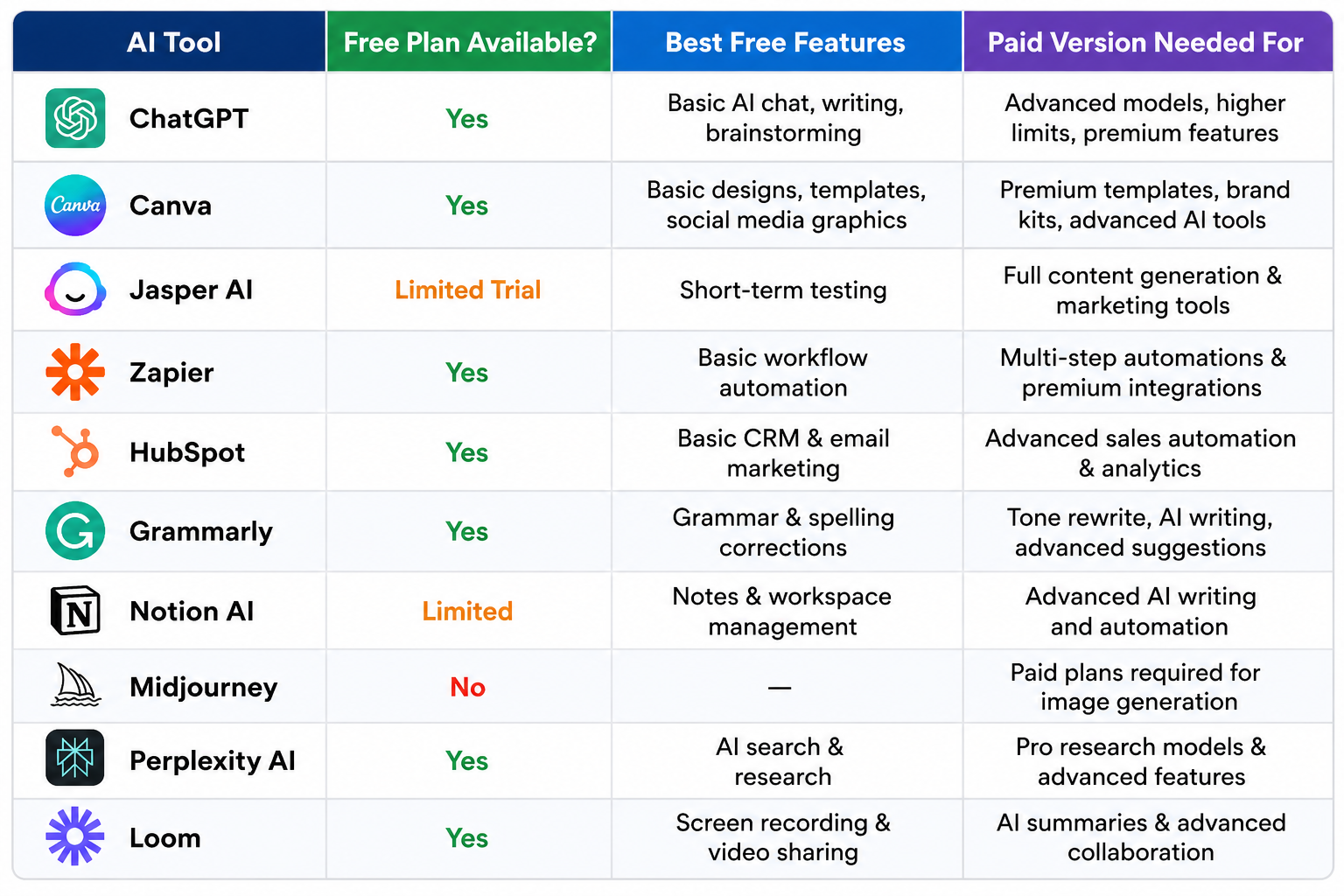
Before choosing an AI tool for your business, it’s important to understand that not every platform is completely free. While many AI tools offer free plans or trial versions, advanced features such as automation, premium templates, higher usage limits, team collaboration, and advanced AI capabilities usually require a paid subscription.
The table below provides a quick overview of the most popular AI tools for small businesses in 2026, including their free features and what additional benefits are available in paid plans. This comparison can help businesses select the right tools based on their budget, goals, and operational needs.
AI tools are no longer optional for businesses that want to remain competitive. Companies using AI report significant time savings, improved efficiency, and better customer experiences. Industry studies show that businesses using AI can save several hours each week while improving revenue growth and operational performance.
The biggest advantage of AI for small businesses is automation. Instead of spending hours on repetitive tasks, business owners can focus on growth, strategy, and customer relationships.
The best AI tools for small businesses in 2026 are those that simplify operations, improve productivity, and help businesses grow faster without increasing costs. Whether you want to automate workflows, create content, improve customer support, or streamline marketing, AI can help your business work smarter.
The key is to start small. Identify one repetitive business process and implement an AI solution to automate it. As your business grows, you can expand your AI stack and unlock even greater efficiency.
Businesses that adopt AI early will have a significant competitive advantage in the years ahead.