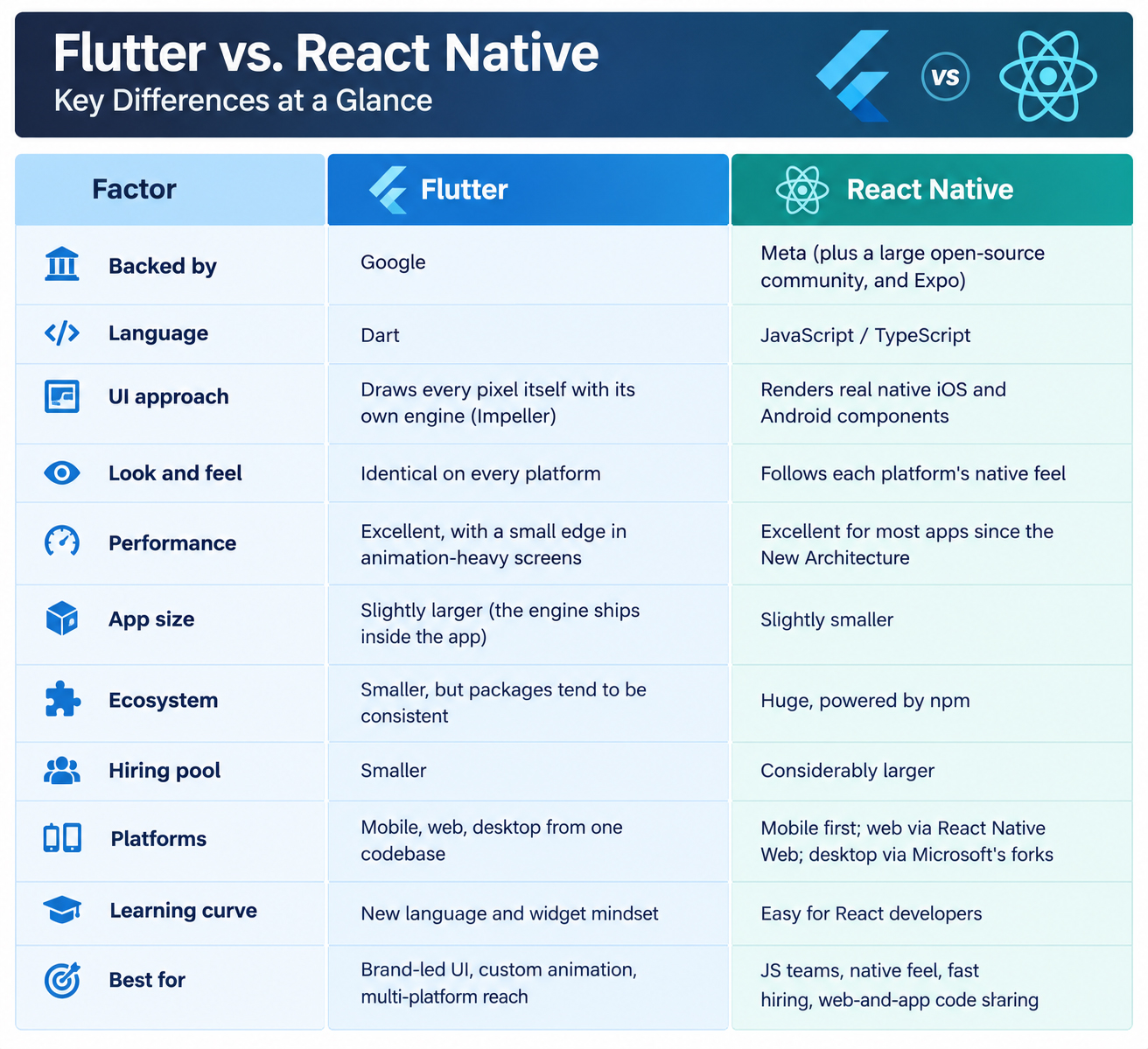
Neither wins every time. Pick React Native if your team already writes JavaScript or React, you want a native look on each platform, or you need to hire quickly. Pick Flutter if you want pixel-identical design on iOS and Android, heavy animation, or one codebase that also covers web and desktop. For most business apps in 2026, either choice will ship well. The wrong choice is usually the one that ignores your team's skills.
If you've been circling this question for weeks, you're in good company. It's the first thing most founders ask us when they come to build an app, and the honest answer has changed more in the last two years than in the five before that.
So here's the version we'd give you across a table at our Noida office: what actually changed, where each framework is genuinely stronger, what it costs, and how to decide without losing a month to research.
A lot of articles ranking for this topic are still arguing about problems that were fixed. Two shifts matter most.
React Native grew up. The old "bridge" that passed messages between JavaScript and native code was the framework's famous bottleneck. The New Architecture (JSI, Fabric and TurboModules) replaced it. It became the default in React Native 0.76 in late 2024, and later releases removed the legacy bridge entirely. If someone tells you React Native is slow because of the bridge, they're describing 2021.
Flutter fixed its jank. Early Flutter apps could stutter the first time an animation ran, because shaders compiled on the fly. Flutter's Impeller renderer, which replaced Skia, compiles them ahead of time. It's now the default on iOS and Android, and that stutter complaint has mostly gone away.
The result: the performance gap that once made this an easy call has narrowed a lot. What's left are differences in philosophy, and those matter more than benchmarks.
| Factor | Flutte | React Native |
|---|---|---|
| Backed by |
|
Meta (plus a large open-source community, and Expo) |
|
Language |
Dart |
JavaScript / TypeScript |
|
UI approach |
Draws every pixel itself with its own engine (Impeller) |
Renders real native iOS and Android components |
|
Look and feel |
Identical on every platform |
Follows each platform's native feel |
|
Performance |
Excellent, with a small edge in animation-heavy screens |
Excellent for most apps since the New Architecture |
|
App size |
Slightly larger (the engine ships inside the app) |
Slightly smaller |
|
Ecosystem |
Smaller, but packages tend to be consistent |
Huge, powered by npm |
|
Hiring pool |
Smaller |
Considerably larger |
|
Platforms |
Mobile, web, desktop from one codebase |
Mobile first; web via React Native Web; desktop via Microsoft's forks |
|
Learning curve |
New language and widget mindset |
Easy for React developers |
|
Best for |
Brand-led UI, custom animation, multi-platform reach |
JS teams, native feel, fast hiring, web-and-app code sharing |
Flutter compiles Dart to native ARM code and renders through its own engine, so it isn't depending on the platform's UI toolkit at all. That gives it predictable frame rates, and in animation-heavy or graphics-heavy screens it still tends to stay a little smoother. Independent benchmarks run in 2026 generally show Flutter holding a modest lead on rendering, while startup times are close.
React Native, after the New Architecture, talks to native code directly through JSI instead of serialising messages across a bridge. Add the Hermes JavaScript engine and a library like Reanimated for animations, and it handles standard business UIs (forms, lists, dashboards, feeds, checkout flows) without users noticing any difference from a native app.
A practical way to think about it: if your app is a marketplace, a booking tool, a fintech dashboard or a delivery app, performance will not be the deciding factor. If it's a game-like experience, a custom-drawn interface, or something with constant complex motion, Flutter earns a closer look.
This is where the two really part ways.
Flutter gives you total control. Because it paints its own UI, your buttons, transitions and typography look exactly the same on a five-year-old Android phone and the newest iPhone. For brand-driven products, that consistency is a gift. Our UI/UX designers love it because what they hand over is what ships.
React Native gives you the platform. It uses real native components, so your app automatically picks up how iOS and Android behave: scroll physics, date pickers, accessibility settings, system updates to the look of the OS. Users who live inside their platform's conventions often prefer it.
Here's where we see projects actually succeed or stall.
If your team already builds a React website, React Native is a short hop. The mental model (components, state, props, hooks) carries over, and a web developer can be productive within weeks. You can also share business logic, validation and API code between your web app and your mobile app.
Flutter asks for a bit more. Dart is a clean, pleasant language, and most developers pick it up in a few weeks, but widgets-all-the-way-down is a different way to think about UI. Flutter's hot reload and tooling are excellent, and many developers say they enjoy working in it more than they expected to.
On hiring, React Native has the bigger talent pool simply because JavaScript is everywhere. Flutter developers are easier to find than they were three years ago, but if you need to scale a team fast in a hurry, the JavaScript pool is wider. Mid-level offshore rates for both skill sets tend to land in a similar band, so the real saving comes from who you can find and how quickly, not from the hourly rate.
Both frameworks save serious money compared with building two native apps, typically by sharing the large majority of code across iOS and Android. Past that, the cost difference between Flutter and React Native is smaller than agencies sometimes imply.
What actually moves your budget:
If someone quotes you a dramatic percentage saving for one framework over the other without asking about your team and your design, treat the quote with suspicion.
React Native plugs into npm, one of the largest software ecosystems in the world, and sits comfortably next to Expo, which is now the standard way most teams start a React Native project. There are more libraries, more tutorials and more answered questions online.
Flutter's package ecosystem on pub.dev is smaller but well curated, and Google's own first-party packages are strong. In practice, you rarely hit a wall in either, but you're more likely to find a ready-made answer in React Native for unusual requirements.
Developer surveys have shown the two close to each other in usage for years. The 2024 Stack Overflow survey had Flutter slightly ahead of React Native among all respondents, while among professionals the two were nearly level. In other words, neither one is a risky bet.
Flutter was built to target mobile, web and desktop from a single codebase, and Dart's WebAssembly compilation continues to improve its web story. If you genuinely want one app on phones, tablets, browsers and desktops, Flutter is the more natural fit.
React Native is mobile-first. You can reach the web through React Native Web, and Microsoft maintains versions for Windows and macOS, but it's more of an assembled toolkit than a single out-of-the-box story. A quick caution for Flutter, though: for content-heavy, SEO-driven websites, a conventional web stack will usually serve you better than Flutter web, since search visibility depends on how a site renders and loads.
Real products help more than brochures. Google Pay, BMW and Alibaba are well-known names that have built on Flutter. React Native powers apps from Shopify, Microsoft and Discord, among many others. Both are proven at serious scale, so the "is it production-ready?" question is closed.
Go with Flutter when:
Go with React Native when:
For apps that lean hard on cutting-edge device features (advanced AR, complex camera pipelines, deep OS-level integrations), fully native Swift and Kotlin can still be the right answer. Kotlin Multiplatform is also gaining ground for teams that want to share logic while keeping fully native UIs. For the typical startup MVP or business app, though, Flutter or React Native will get you to market faster and cheaper, without a painful compromise on quality.
Try this quick decision path:
And if you're still not sure, that's normal. The right answer depends on your product, team and roadmap, which is exactly what a short discovery conversation is for.
We're a Noida-based team that has delivered more than 1,800 projects for clients across India, the USA, the UK, Canada, Australia, New Zealand and the UAE. Our hybrid and cross-platform app development work covers both Flutter and React Native, and we recommend whichever fits your project, not whichever we happen to prefer.
Here's how we typically work with you:
Is Flutter better than React Native in 2026?
Not universally. Flutter has a slight edge in rendering performance and UI consistency, and it covers more platforms from one codebase. React Native has a larger ecosystem and hiring pool, and feels more native. The better framework is the one that matches your team and your product.
Is React Native still relevant in 2026?
Yes. Its New Architecture is now the default and the old bridge has been removed, which closed much of the historic performance gap. It remains one of the two leading cross-platform choices and is used by major companies.
Which is faster, Flutter or React Native?
Flutter is often a little faster in animation-heavy and graphics-heavy screens. For standard business apps, the difference is small enough that users won't notice it.
Is Flutter or React Native cheaper to develop with?
Neither is reliably cheaper. Costs depend on your design complexity, integrations and the skills your team already has. Both are significantly cheaper than building two separate native apps.
Which is better for a startup MVP?
If you have JavaScript or React developers, React Native is usually the fastest route. If you're starting from scratch and want a polished, custom UI, Flutter is a strong choice. Both work well for MVPs.
Is Flutter good for web apps?
Flutter supports web and works well for app-like experiences such as dashboards and internal tools. For content-led, SEO-dependent sites, a traditional web stack is usually the better pick.
Is it hard to switch from React Native to Flutter, or the other way around?
Not impossible, but it's a rewrite, not a conversion, because the languages and UI models differ. A React Native developer typically becomes productive in Flutter within a few weeks. Choosing well up front saves the pain.
Can Gleaming Media Technologies build my app in Flutter or React Native?
Yes. We build with both and will recommend the right one after understanding your project. Get in touch for a consultation.